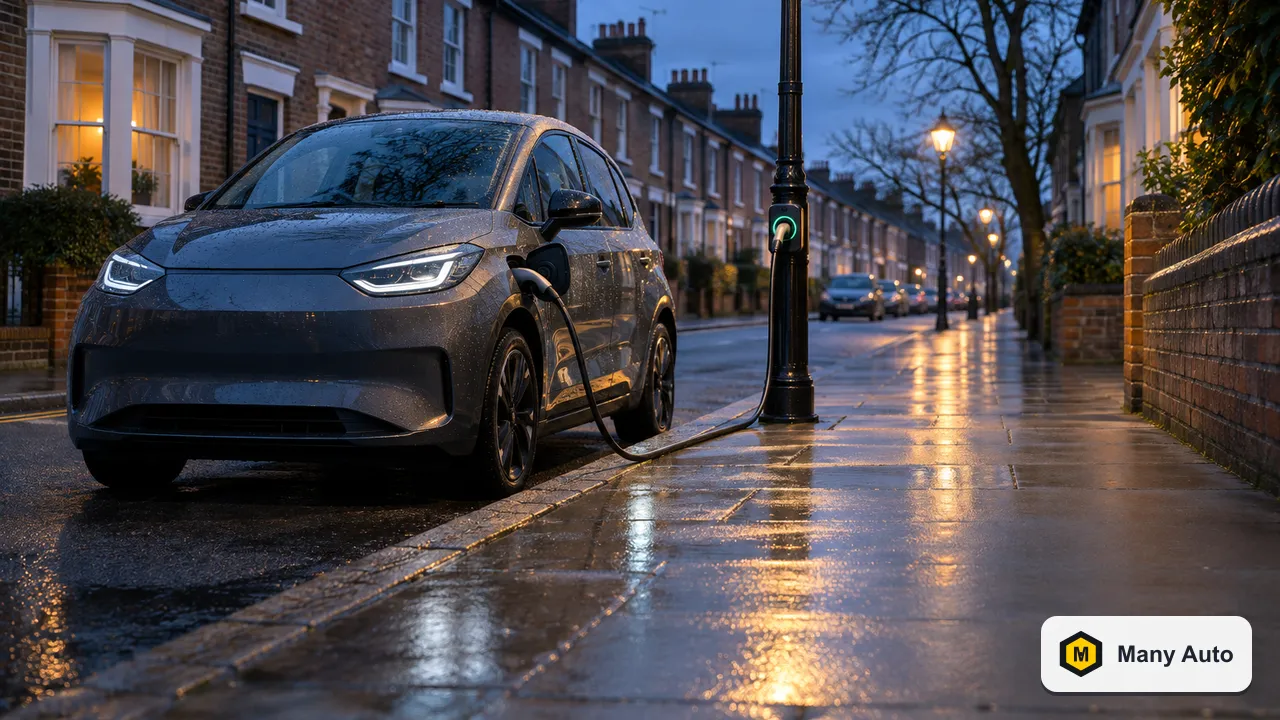
Running an electric car without a driveway is perfectly workable, but it costs more per mile than charging at home, and in winter the gap is easy to feel. Zapmap's price index for October 2026 put the average pay-as-you-go price at 54p per kWh on slow and fast public chargers and 82p per kWh on rapid and ultra-rapid ones, against roughly 26p at home on the energy price cap and about 8p on an off-peak EV tariff. The Budget on 28 October promised £100 million over two years to bring down costs at local, lower-powered public chargers from spring 2027, plus a taskforce on letting drivers use their home tariff at those chargers. Neither helps this winter, so the savings for now come from choosing where and when you plug in.
Why public charging costs more
Part of the difference is VAT. Household electricity carries a reduced rate, and the Budget extended the current VAT cut on household electricity to July 2027. Public charging is charged at 20% VAT, and What Car?'s summary of the Budget notes that this stays the case. The rest is the cost of the equipment, the grid connection, the operator's margin and, for rapid chargers, the price of delivering a lot of power quickly.
The current prices, side by side
From the Zapmap charging price index for October 2026:
| Where you charge | Typical price per kWh |
|---|---|
| Home, off-peak EV tariff | about 8p |
| Home, standard price cap rate | about 26p |
| Public slow and fast (3kW to 49kW) | 54p average |
| Public rapid and ultra-rapid (50kW and above) | 82p average |
To turn that into pence per mile, divide by how many miles your car covers per kWh. A car managing 3.5 miles per kWh costs about 15p a mile at 54p, and over 23p a mile at 82p. In cold weather the miles per kWh drop, so the cost per mile rises even if the tariff does not.
Zapmap also notes that many networks charge less than these averages and that subscriptions and promotions can bring prices down. The average is a guide, not the price you are stuck with.
A sensible routine without home charging
Drivers who make this work tend to settle into a pattern rather than charging wherever they happen to be.
- Make a slow charger your "home" charger. A lamp-post or kerbside charger on your street, a council car park, or a supermarket with slower units. These are cheaper per kWh than rapids and suit overnight or shopping-length stops.
- Use workplace charging if you have it. Some employers offer it free or at cost. Ask; it is often under-used.
- Save rapid charging for journeys. On a long trip a rapid charger is worth paying for. As a weekly habit it is the most expensive way to run the car.
- Look at subscriptions on the networks you actually use. If one operator covers your area and your regular routes, a monthly plan that lowers the per-kWh price can pay for itself quickly. If you only use a network occasionally, it probably will not.
- Charge to what you need. On rapid chargers the charging speed usually tails off at higher states of charge, so stopping around 80% saves time, and on time-based tariffs it saves money too.
Winter makes the numbers worse
Cold batteries charge more slowly and the car uses energy to heat the cabin and the battery. Expect fewer miles from each kWh between November and March. A few things soften the effect:
- Pre-heat the car while it is plugged in, where your charger and car allow it, so the energy comes from the charger rather than the battery.
- Use heated seats and a heated steering wheel rather than heating all the cabin air; they use far less energy.
- If your car can precondition the battery before a rapid charge, enter the charger as the destination in the car's own satnav so the battery arrives warm.
Our EV basics guide goes into winter range in more detail, and the winter driving checklist covers the bits that apply to any car, such as tyres and visibility.
What the £100 million is for
The Budget 2026 document says the money is meant to cut costs at local, lower-powered public chargers from spring 2027, with an expected saving of around £150 a year for an average on-street EV driver without home charging. The Department for Transport is due to set out how it will work. Separately, a taskforce will look at letting drivers use their own home electricity tariff at local public chargers; no timetable has been given.
Until the detail is published, nobody can tell you which chargers will qualify or how the discount reaches you. It is reasonable to expect slow kerbside and car park chargers to be the focus, given the wording, but treat that as an expectation rather than a fact.
A note on cables across the pavement
If you are tempted to run a cable from your house to the kerb, do not just trail it across the footway. It creates a trip hazard and you could be liable if someone is hurt. Some councils run approved schemes with channels set into the pavement; ask yours what is allowed before buying anything.
Looking further ahead
From April 2028 electric cars will also pay eVED, a mileage charge of 3p a mile, which we explain in a separate article. That applies whether you charge at home or on the street, so it does not change the home-versus-public comparison, but it does belong in any running-cost sum you do.
A rule of thumbIf more than a quarter of your charging is on rapid chargers and you are not doing long journeys, there is probably a cheaper pattern available to you. Look at the slow chargers within a short walk of home, work and the shops you visit weekly.