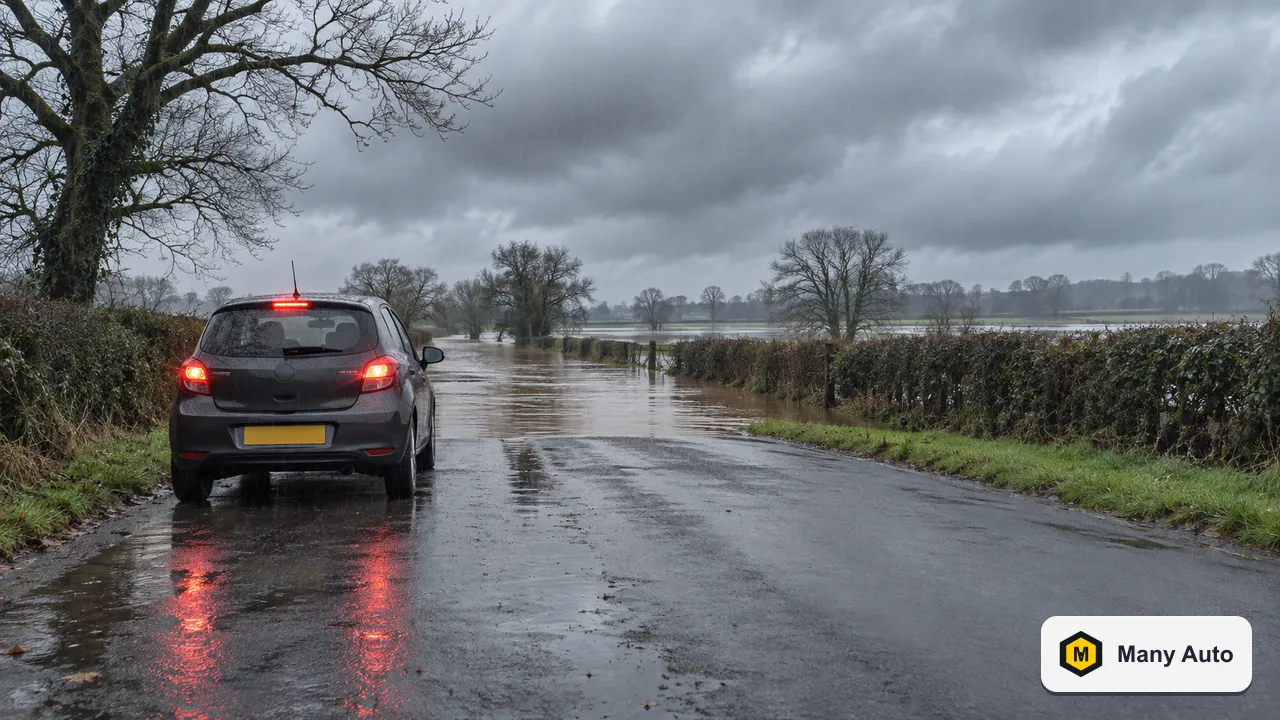
If you cannot see the road surface under the water, or you do not know how deep it is, turn round. That is the whole of the advice that matters. Fire and rescue services treat anything over about 10cm as too deep for an ordinary car, the Environment Agency has warned that 30cm of moving water can float a car, and at around 60cm most cars will be carried away. The 2026/27 storm season has already brought Storm Austen and Storm Boelo in late October, so roads that flood in heavy rain are likely to do so again this winter. A detour costs minutes; a flooded engine or a car swept off a lane costs far more.
How little water it takes
North Yorkshire Fire and Rescue's floodwater advice for drivers sets out the depths most services use:
- About 10cm: widely treated as the sensible limit for a normal car, though vehicles differ.
- 30cm: enough to move your car.
- Around 60cm: deep enough for the car to float away.
An older joint warning from the Environment Agency and the AA put it bluntly: just one foot of moving water can float your car. The same release recorded that the AA had carried out more than 21,000 flood rescues between 2009 and 2014, which gives a sense of how often drivers misjudge it.
Depth is hard to read from the driver's seat. Water across a dip in the road is often deeper in the middle than it looks at the edge, the surface may have washed away underneath, and moving water pushes harder than it appears.
Before you set off in a storm
The Met Office names storms when they could bring amber or red warnings. Its storm centre lists this season's names, starting with Austen and Boelo, which were named on 20 and 22 October 2026. When a warning covers your route:
- Ask whether the journey can wait. Most can, by a few hours.
- Check flood warnings for the whole route, not just your start and end points. Low roads near rivers, fords and underpasses are the usual trouble spots.
- Plan a detour in advance so you are not making the decision at the water's edge in the dark.
- Charge your phone and tell someone your route if you are heading somewhere remote.
A designated ford is not automatically safe. Water depth and speed change quickly after rain, and a crossing you used last week may be impassable today.
If the water is shallow and you must go through
Sometimes the only way out is through a short, shallow stretch you can see across. The fire service guidance for that situation:
- Wait for oncoming traffic to clear. A vehicle coming the other way pushes a bow wave that can swamp your car.
- Drive through the middle of the road, which is usually the highest point.
- Go slowly in first gear, at around 3 to 4mph.
- Do not stop part way across.
- Once you are out, and it is safe, test your brakes gently. Wet brakes can feel weak until they dry.
The Highway Code's rules for adverse weather add that stopping distances are at least double on wet roads, and that strong gusts can push cars off course on exposed roads and near bridges. In a storm the risks stack up: standing water, poor visibility and wind together.
Why a little water can wreck an engine
A petrol or diesel engine breathes through an air intake that can sit surprisingly low at the front of the car. If water is drawn in, it cannot be compressed the way air can, and the result can be bent internal parts and an engine that is beyond economic repair. If the engine stalls in water, do not try to restart it. Call your breakdown provider and wait for help in a safe place. Electric cars do not have an air intake, but water can still damage electrical systems and bearings, and they float just as readily.
If you are caught by rising water
If water is rising around a stationary car, your safety comes first and the car does not matter. Call 999. If water is flowing strongly, stay put and wait for rescue rather than wading, unless you are in immediate danger. Moving water can knock an adult off their feet at shallow depths and hides drains, debris and missing covers.
Afterwards
Even if the car seems fine, have it checked if water came above the sills, into the footwells, or near the air intake. Signs to look for in the following days:
- A damp smell or misting that will not clear, which suggests water inside.
- Warning lights that come and go.
- Brakes that feel different once dry.
- Unfamiliar noises; our guide to what car noises usually mean can help you describe them to a garage.
Speak to your insurer before arranging major repairs. Check your policy wording on flood damage and on whether driving into floodwater against warnings affects cover.
Buying a used car after a wet winter
Flood-damaged cars sometimes reappear for sale. Tide marks under the carpets, rust in odd places like seat runners, silt in the spare wheel well and a musty smell are all worth investigating. Our used-car guide covers the general checks, and a seller who cannot explain wet carpets is a reason to walk away.
RememberIf in doubt, turn round. Check flood warnings for the whole route before a storm, and never drive into water you cannot see the bottom of.
For the rest of the season's preparation, from tyres to screenwash, see our winter driving checklist.